
Incoterms® is a registered trademark of the International Chamber of Commerce (ICC). The use of this trademark does not imply any affiliation with the ICC, nor that such use is authorized or sponsored by the ICC.
In international trade, a key factor in negotiations is which party bears the costs and risks of transportation. Buyers and sellers can agree on obligations individually. However, especially in international contracts, misunderstandings can arise due to different legal systems and languages.
To ensure uniform use of delivery terms, the International Chamber of Commerce (ICC) has clearly defined standardized commercial clauses (“International Commercial Terms” – in short: Incoterms). These can be used globally to regulate the content of delivery terms and the obligations of the parties. The use of Incoterms enables an internationally uniform interpretation of contractual obligations and risks associated with the transport of goods.
The Incoterms are revised every ten years by the International Chamber of Commerce to adapt them to developments in global trade. The currently latest version is Incoterms® 2020. In principle, the contracting parties are free to use an older version – such as Incoterms® 2010. The indication of the year is crucial, as the meaning of individual clauses can change between versions.
Although they are standardized clauses regulating certain rights and obligations, they are not mandatory. The contracting parties have the possibility to modify or supplement individual regulations.
Incoterms regulate:
Place of transfer of risk
Place of transfer of costs
Transfer of duty of care
Allocation of handling activities
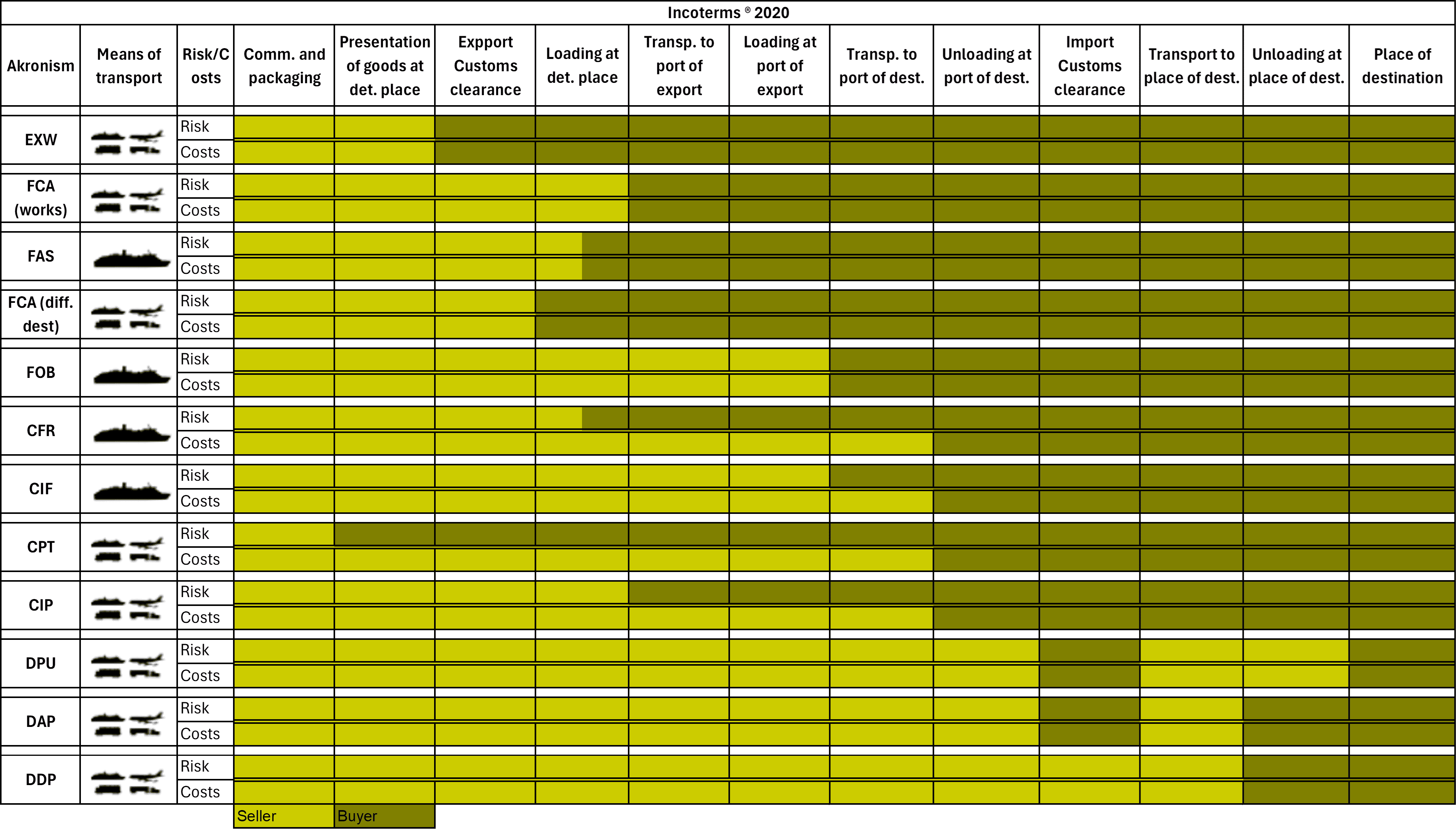
Clauses for all modes of transport:
EXW – Ex Works
FCA – Free Carrier
CPT – Carriage Paid to
CIP – Carriage, Insurance Paid to
DAP – Delivered At Place
DPU – Delivered At Place Unloaded
DDP – Delivered Duty Paid
EXW – Ex Works
EXW means that the seller makes the goods, ready for shipment and packed, available for loading at the manufacturing site. By doing so, the seller fulfills his obligations. The risk of accidental loss passes to the buyer at the earliest possible point. The buyer must collect, load, and transport the goods. Any necessary customs formalities, such as export or import, are also the responsibility of the buyer. He must also arrange insurance for the transport to cover risks and bear the costs.

FCA – Free Carrier (Frei Frachtführer)
According to the FCA Incoterm, the seller makes the export-ready goods available at a defined location. The seller bears the risks and costs for clearing the goods for export and loading, provided this takes place at the manufacturing site. If loading occurs at another specified location, the buyer bears the costs and risks for loading. As with EXW, the buyer also bears the costs and risks for transport and insurance.

CPT – Carriage Paid to
If the parties agree on the Incoterm CPT, the seller must clear the goods for export and deliver them to the specified destination. He bears the transport costs incurred up to that point. The seller is only responsible for risks of loss or damage up to the first loading before transport to the export port. The buyer must unload the goods at the specified destination and bear the costs for onward transport. He assumes risks from the first loading.

CIP – Carriage, Insurance Paid to
The buyer and seller have the same obligations as with CPT. However, under this Incoterm, the seller must also bear the insurance costs for transport to the destination in addition to the freight costs.

DPU – Delivered At Place Unloaded
When agreeing on the DPU Incoterm, the seller must unload the export-cleared goods at the destination. Until unloading is completed, he bears both the costs for transport and insurance as well as the risks of loss or damage. The buyer bears the costs for importing the goods into the destination country.

DAP – Delivered At Place
If the DAP Incoterm is agreed, the seller bears the transport and insurance costs and risks up to the agreed destination, where the goods are made available to the buyer for unloading. For cross-border shipments, the seller is responsible for export clearance in the departure country, but not for import clearance in the destination country. The buyer must take care of import and unload the goods at the destination.

DDP – Delivered Duty Paid
Under the DDP Incoterm, as with DAP, the seller bears the transport and insurance costs as well as the risks up to the agreed destination. Unlike DPU, it is the buyer who must unload the goods at the destination. The seller must clear the goods for export in the departure country, and in addition, he must import the goods into the destination country and bear the costs of customs clearance. He must also pay import duties (customs and import VAT). The DDP Incoterm is the only one where the seller must bear the costs of import.

Clauses only for sea and inland waterway transport:
FAS – Free Alongside Ship
FOB – Free on Board
CFR – Cost and Freight
CIF – Cost, insurance and Freight
FAS – Free Alongside Ship
The FAS Incoterm means that the seller fulfills his delivery obligations when he has made the goods available alongside the ship at the named port of shipment. From then on, the buyer bears the costs for transport and insurance as well as the risks for loss or damage.

FOB – Free on Board
When agreeing on the FOB Incoterm, the seller has fulfilled his obligations when the goods have crossed the ship’s rail at the named port of shipment. Until this point, the seller bears both the costs for transport and insurance as well as the risks. Once the goods are loaded at the named port of shipment, the buyer assumes the costs and risks for transport, insurance, and loss or damage.

CFR – Cost and Freight
When agreeing on the CFR Incoterm, the seller must transport the goods to the named destination port and bear the associated costs. The seller bears the risks until the goods have crossed the ship’s rail at the port of shipment.

CIF – Cost, Insurance and Freight
As with the CFR Incoterm, the seller has delivered the export-cleared goods when loading on board at the port of shipment has taken place. Until this point, the seller also bears the risks for loss or damage. The seller bears the costs for transport and insurance up to the named destination port.

The Incoterm used for a transaction must be specified in the customs declaration in the importing country. Depending on the agreed Incoterm, transport costs must be added to the invoice price. These costs may include transportation, insurance, loading, and handling costs for the imported goods that are related to transportation. The Incoterms regulate up to what point these costs are already included in the purchase price.
Incoterms are also relevant for determining the place of supply for VAT purposes. They indicate when, according to the contractual agreement, the power of disposition passes from the seller to the buyer. They also clarify who, according to the contractual agreement, is responsible for the different segments of transport.
In both cases, however, Incoterms only have indicative effect. The actual arrangement of transportation is decisive. If this deviates from the contractual agreement, Incoterms have no binding effect.
Contact


